
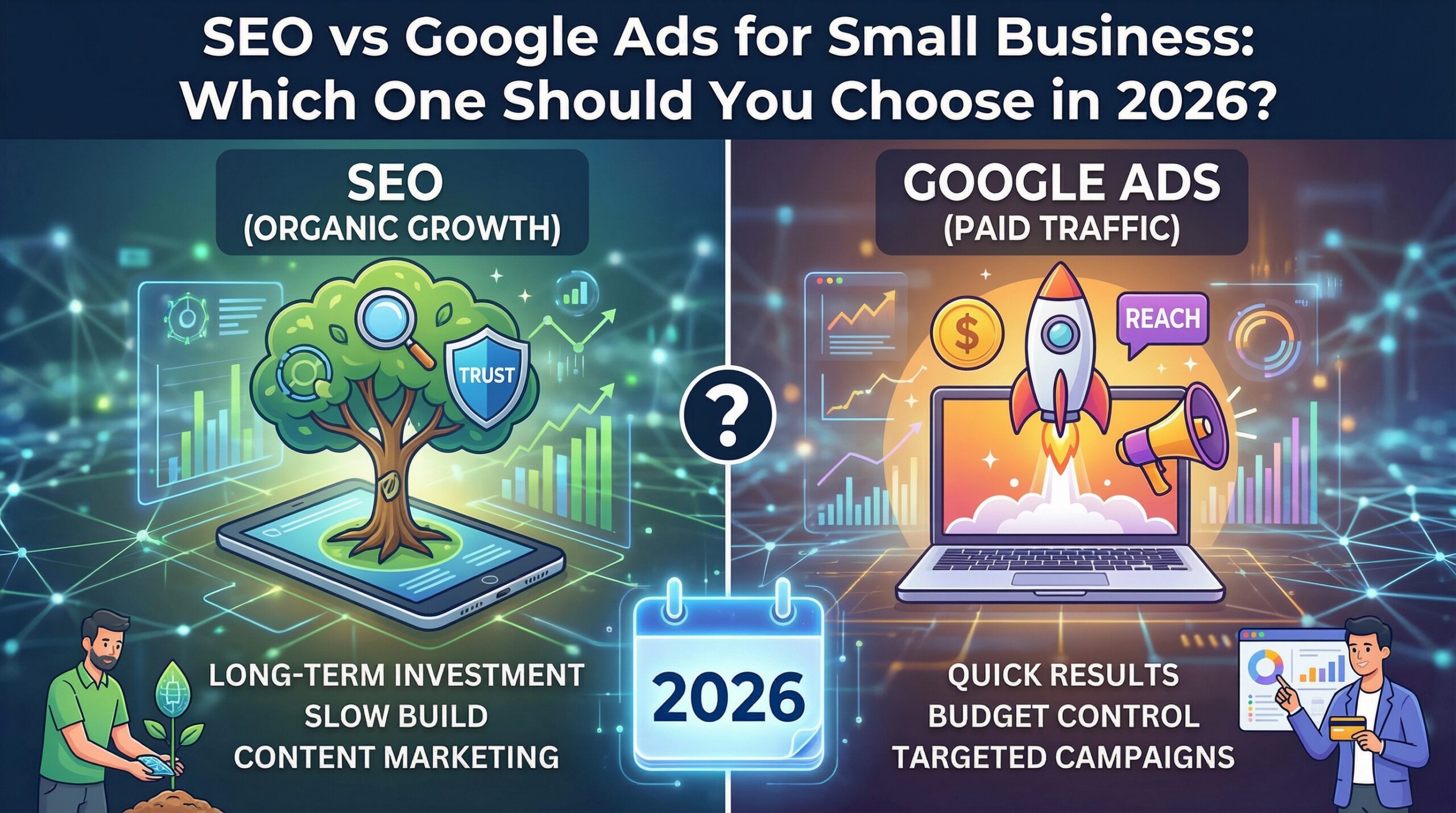
If you’re a small business owner trying to grow online in 2026, chances are you’ve asked this exact question:
Should I focus on SEO or Google Ads?
Or more specifically:
SEO vs Google Ads for small business which one actually makes sense for me right now?
It’s a fair question. Both promise visibility. Both can drive traffic. Both can work.
But they work very differently, cost money in different ways, and suit different stages of business growth.
I’ve seen small businesses waste months doing the wrong one at the wrong time. I’ve also seen businesses grow steadily by choosing the right approach even with limited budgets.
So in this guide, I want to break this down clearly, without jargon, without hype, and without pushing one option as “the best” for everyone.
By the end, you should be able to decide:
- SEO or Google Ads which fits your situation
- What results to realistically expect
- And how small businesses can use both together intelligently
The Big Picture: SEO vs Google Ads for Small Business in 2026
Before comparing features, let’s zoom out.
In 2026, digital marketing choices for small businesses are harder not easier.
- Competition is higher
- Ads are more expensive
- Attention spans are shorter
- Customers research more before buying
That means choosing the right online marketing strategy in 2026 matters more than ever.
SEO and Google Ads are not enemies.
They’re tools.
And tools only work when used for the right job.
What Is SEO? (In Simple Terms)
SEO (Search Engine Optimization) means improving your website so it shows up organically on Google when people search for things related to your business.
You don’t pay Google directly for each click.
Instead, you earn traffic by being relevant, helpful, and trustworthy.
SEO looks like:
- Creating useful content
- Optimizing pages for search intent
- Improving website structure
- Building long-term visibility
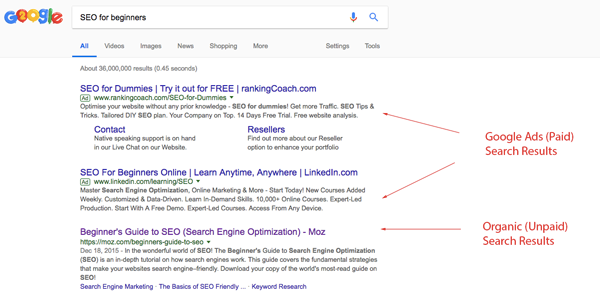
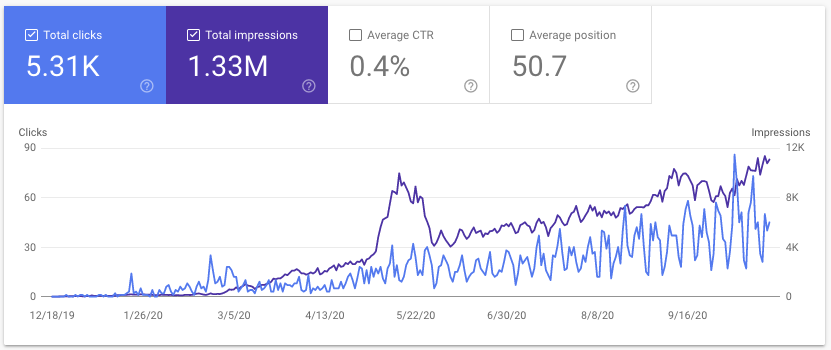
SEO is slow but powerful.
What Are Google Ads? (In Simple Terms)
Google Ads lets you pay to appear at the top of search results instantly.
You choose keywords, set a budget, and your ad appears when someone searches for those terms.
You pay per click, not per impression.
Google Ads looks like:
- Immediate visibility
- Fast testing
- Paid traffic
- Campaign optimization

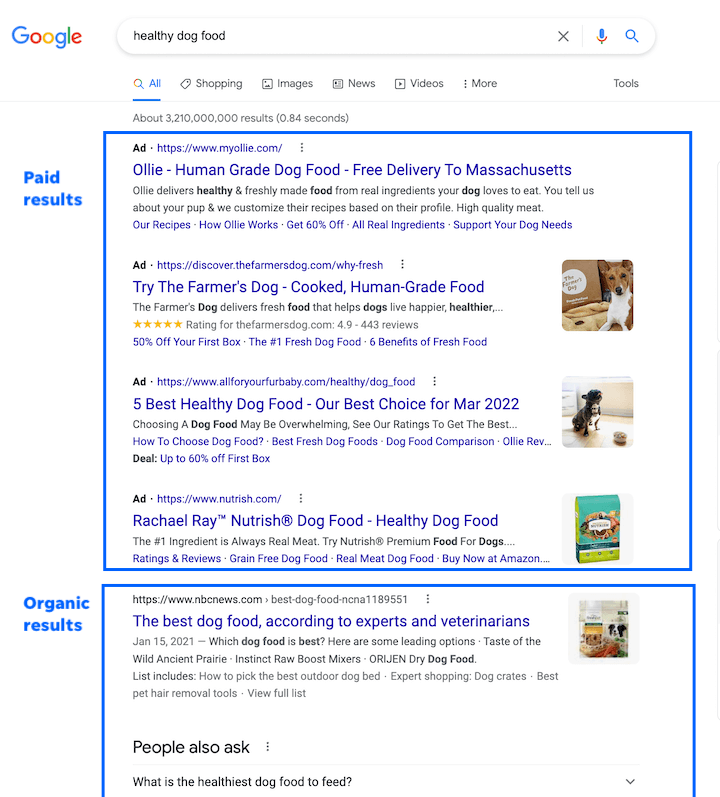
Google Ads is fast but temporary.
SEO vs Google Ads for Small Business: Side-by-Side Comparison
Let’s compare them across the areas that actually matter to small businesses.
1. Cost: SEO vs Google Ads for Small Business
SEO Cost
SEO doesn’t charge per click, but it’s not “free.”
You pay with:
- Time
- Content creation
- Tools
- Learning or consulting
Once SEO starts working, traffic continues without paying Google each time.
Long-term cost: lower
Short-term cost: time-heavy
Google Ads Cost
Google Ads costs money every time someone clicks.
In competitive industries:
- Clicks can be expensive
- Costs increase over time
- Bad setup burns money fast
Short-term cost: higher
Long-term cost: ongoing
Cost Verdict
- Tight budget + patience → SEO
- Budget available + urgency → Google Ads
This is one of the most important factors in SEO vs Google Ads for small business decisions.
2. Timeline: How Fast Do You See Results?
SEO Timeline
SEO is a long game.
Typical expectations:
- 3–6 months: early movement
- 6–12 months: meaningful results
- Long-term: compounding growth
SEO rewards consistency.
Google Ads Timeline
Google Ads can bring traffic the same day.
You can:
- Launch today
- Get clicks tomorrow
- Pause anytime
But results stop when you stop paying.
Timeline Verdict
- Need results now → Google Ads
- Willing to build slowly → SEO
3. Learning Curve: SEO or Google Ads?
SEO Learning Curve
SEO requires:
- Understanding search intent
- Writing helpful content
- Technical basics
- Patience
It’s not hard—but it’s deep.
Google Ads Learning Curve
Google Ads looks easy, but:
- Poor targeting wastes money
- Bad landing pages kill ROI
- Small mistakes get expensive
The platform is technical and unforgiving.
Learning Curve Verdict
- Willing to learn gradually → SEO
- Prefer structured testing → Google Ads (with caution)
4. Goals: What Are You Trying to Achieve?
This is where many businesses get stuck.
SEO Is Best For:
- Long-term brand building
- Authority and trust
- Consistent inbound leads
- Content-driven growth
Google Ads Is Best For:
- Immediate leads
- Promotions
- Testing offers
- Time-sensitive campaigns
Goal Alignment Matters
If your goal is sustainability → SEO
If your goal is speed → Google Ads
Choosing the wrong tool leads to frustration.
5. ROI: SEO vs Google Ads for Small Business
SEO ROI
SEO ROI improves over time.
- Traffic compounds
- Costs stabilize
- Trust increases
- Leads become cheaper
SEO is an asset.
Google Ads ROI
Google Ads ROI depends on:
- Offer quality
- Conversion rate
- Cost per click
- Funnel efficiency
When it works, it works well.
When it doesn’t, it drains budgets.
ROI Verdict
- Long-term ROI → SEO
- Short-term ROI → Google Ads
Best Marketing for Small Business: Which One Should You Choose?
There’s no universal answer but there is a right answer for your situation.
Choose SEO If:
- You want sustainable growth
- You’re building a brand
- You can wait for results
- You prefer long-term assets
SEO is often the best marketing for small business aiming for stability.
Choose Google Ads If:
- You need leads quickly
- You’re validating a new offer
- You have budget flexibility
- You understand conversion basics
Google Ads works best when systems are ready.
When SEO and Google Ads Work Best Together
Here’s the part most blogs skip.
The smartest small businesses don’t choose SEO or Google Ads.
They use both strategically.
How to Combine Them:
- Use Google Ads for quick leads
- Build SEO for long-term traffic
- Use ad data to improve SEO keywords
- Retarget visitors organically later
This creates balance.

In 2026, the strongest online marketing strategy is layered, not isolated.
Common Mistakes Small Businesses Make
Let’s save you some pain.
Mistake #1: Starting Google Ads With No Website Strategy
Traffic without conversion is wasted money.
Mistake #2: Expecting SEO Results in 30 Days
That’s not how SEO works.
Mistake #3: Copying Competitors Blindly
What works for them may not work for you.
Mistake #4: Choosing Based on Trends
Choose based on business reality, not hype.
SEO vs Google Ads for Small Business in 2026: Final Recommendation
Here’s the honest takeaway.
- SEO builds assets
- Google Ads buys attention
- Small businesses need clarity, not tactics
If you’re early-stage, SEO often gives the best foundation.
If you’re time-sensitive, Google Ads can help—carefully.
If you’re growing, combining both is powerful.
The real win isn’t choosing the “better” channel.
It’s choosing the right one at the right time.
If you’re still trying to understand what digital marketing actually means for a business in today’s world, I’ve explained it in detail in Digital Marketing for Business Explained: Why You Need It in 2026, where I break everything down in simple, practical terms for beginners.
Final Thoughts
The SEO vs Google Ads for small business debate isn’t about right vs wrong.
It’s about:
- Timing
- Budget
- Goals
- Capacity
In 2026, the businesses that win online won’t chase every option.
They’ll make intentional digital marketing choices, start small, measure results, and adjust intelligently.
That’s how growth becomes sustainable without burning out or burning cash.
At Digital Abdul, we help small businesses cut through the noise and choose digital marketing strategies that actually make sense for their stage of growth, budget, and long-term vision.